The final kicked off at 3.06 in the morning here, on a Monday. It went to extra time. Anyone who stayed for Ferran Torres in the 106th minute watched Spain take it 1-0 off Argentina at somewhere around a quarter past five, in front of 80,663 people at MetLife, then showered and went to work. Offices across Klang Valley ran on very little sleep that day and a great many people wore a shirt about it.
Two things before the lessons. First, this is a trends piece for brands, not a guide to official merchandise: Goldvest is not affiliated with, licensed by or supplying FIFA or any team, and nothing here is an endorsement. Second, and more usefully, the licensing question turns out not to matter much. The expanded 48-team tournament ran from 11 June to 19 July across the United States, Canada and Mexico, and for five weeks apparel stopped being clothing and became a way of saying which side you were on. That is the asset. Nobody licenses attention.
The brands that won it never touched a crest
A tournament this size converts clothing into identity, and it does it for everyone in range, not only the companies who paid to be official. Fans wear a shirt to declare a side. Workplaces run watch parties and dress-down mornings. Brands of every size launch something to catch the mood. That mix of emotion, timing and near-universal attention is why apparel volumes spike around a World Cup, and 2026 behaved exactly to type.
Here is the part worth keeping, and it is the opposite of what most people assume. The companies that got the most out of it were not the ones chasing a crest they had no right to use. They were the ones who put their own people into a good run of branded shirts and let staff and customers feel part of the occasion while carrying the correct logo — theirs. Sponsorship buys association. A well-made shirt in your own colours, handed out in the right week, buys the same thing at a fraction of the cost and none of the legal exposure.
FIFA argued about the heat all summer. The fabric answer was already settled.
The biggest change in performance shirts over the past decade is the material. Cotton has largely given way to engineered knits built from recycled polyester — often spun from post-consumer bottles and sold as rPET — because it is light, holds colour and, critically, moves moisture off the skin instead of drinking it in. Match and training shirts now layer those knits with ventilation zones, mesh panels and body-mapped construction.
In 2026 that stopped being a spec-sheet nicety. FIFA made three-minute cooling breaks mandatory in every match regardless of conditions, which produced the tournament's most argued-about decision: the breaks were booed in air-conditioned stadiums, broadcasters ran commercials inside them, and a letter coordinated by the New Weather Institute and signed by dozens of players pushed FIFA to strengthen its heat protocols after afternoon kickoffs during a heat dome over the eastern United States in the knockout round. The irony is that the final itself was played in about 27°C and 40% humidity — pleasant, by the standards of the fortnight before it. The argument was never really about the breaks. It was about kit and kickoff times, and one of those two is something you can actually specify.
For decoration, dye-sublimation has become the default for all-over graphics: the design is infused into the polyester with heat rather than sitting on top of it, so it will not crack, peel or lift the way a heavy plastisol print on synthetic eventually does. Hold the trade in mind rather than the marketing. Sublimation gives vivid, full-coverage, durable graphics — but only on polyester, and only in light base colours unless you are printing on pre-dyed stock. Silkscreen and heat transfer still earn their place for simple marks, exact spot colours and cotton blends. Ask which one your artwork is actually suited to before you fall in love with a mock-up.
The fit is a preference. The size curve is a failure point.
Football kit comes in two cuts. Player or authentic fit is close and athletic, built to move with the body. Fan or replica fit is relaxed and forgiving, built to survive a full day. For a corporate or team order the fan cut is almost always the safer call — it flatters a wider range of bodies and reads as everyday wear rather than as sportswear somebody was told to put on.
Sizing is where team apparel orders actually go wrong, and it goes wrong the same way every time. Somebody orders a flat curve — equal quantities of S through XXL, or worse, mostly M and L because that is what the catalogue suggests — and on the morning of the photo, a third of the office is in something that does not fit. Polyester athletic cuts run smaller than a standard cotton tee, sometimes by a full size. Two things prevent it: collect actual sizes from actual people before you order, and get one physical sample of the exact style in your hands and put it on a real person, because a size chart is a table of intentions, not measurements.
In Malaysia the merch moment was never the stadium. It was the mamak at 4am.
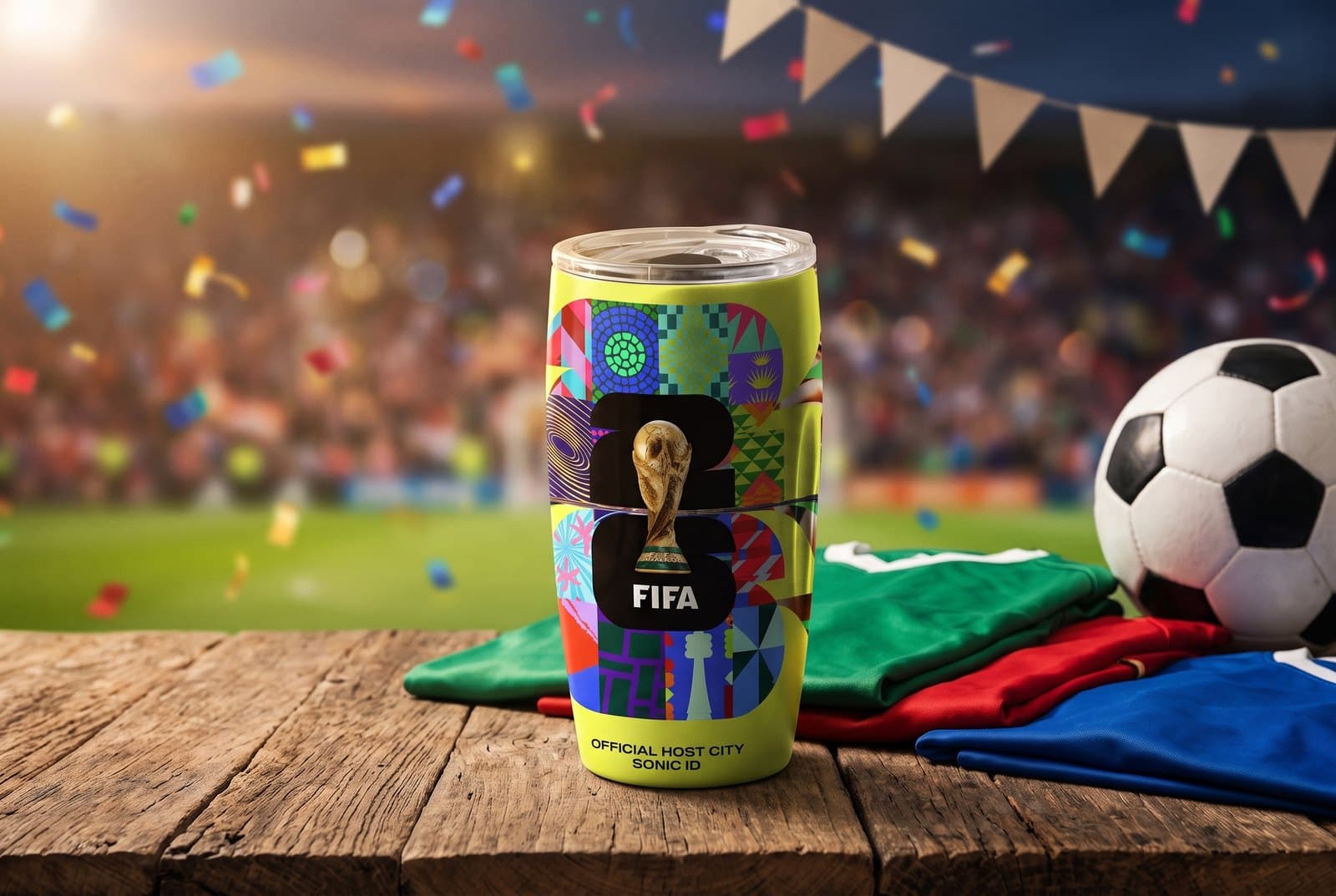
Shirts take the headlines, but the wave runs much wider and the accessories are frequently better value and easier to brand. Scarves remain the classic fan item. Caps and bucket hats have become ordinary daywear. Enamel pins, patches and lanyards make cheap collectables that people genuinely keep. Tote bags, tumblers and insulated bottles carry a logo long past the final whistle.
For a Malaysian audience, though, the timing said something specific. With kickoffs landing roughly between 3am and 10am our time, nobody here was buying stadium wear. They were buying gathering wear. The office breakfast viewing, the pre-dawn mamak table, the branded tumbler and a comfortable tee at four in the morning — that was the occasion, and it is a far better brief than 'World Cup merchandise' ever was. Which is why the sharpest local play was the watch-party pack: a tee, a cap or scarf, a drink cooler and a few things to eat, in a printed box. Several items, one occasion, one memory.
And the fabric argument does not expire with the tournament. A moisture-wicking performance tee is not a match-day novelty in a country where it is 32°C in November. It is the shirt people keep reaching for, which is the only durable form of brand impression there is.
Book the next one before everybody else does
The intellectual property line is simple and worth stating plainly, because getting it wrong is expensive and entirely avoidable. Use your own logos, colours and slogans. Stay well clear of team crests, official tournament names and marks, trophies and player likenesses — all protected, all enforced. Never imply your merchandise is official or endorsed. Inside those lines there is a great deal of room: sublimated team-style jerseys in your brand colours, numbered squad tees for staff, campaign caps, a watch-party pack for clients.
The other lesson is about the calendar, and it is the one that costs money. The entire industry orders the same blanks and books the same decorators in the run-up to a marquee event, so capacity tightens and prices firm as it approaches. Artwork is the usual bottleneck, and it is nearly always the client's: a logo arrives as a 400-pixel JPEG lifted off a website, and somebody has to redraw it as vector before a single shirt can be sublimated. That redraw is days, not minutes, and it happens after you thought you had ordered. The brands that got good stock at good prices in 2026 locked styles, sizes and print-ready artwork in early. When the next moment appears on the calendar, start before the market does.
Bring us your brief.
Thinking about branded kit for the next big season? Tell us your colours, your quantities and the date it has to be in people's hands — send the logo in vector if you have it — and we will come back with fabric options, mock-ups and a plan that gets your team kitted out well before the rush.
Start a brief