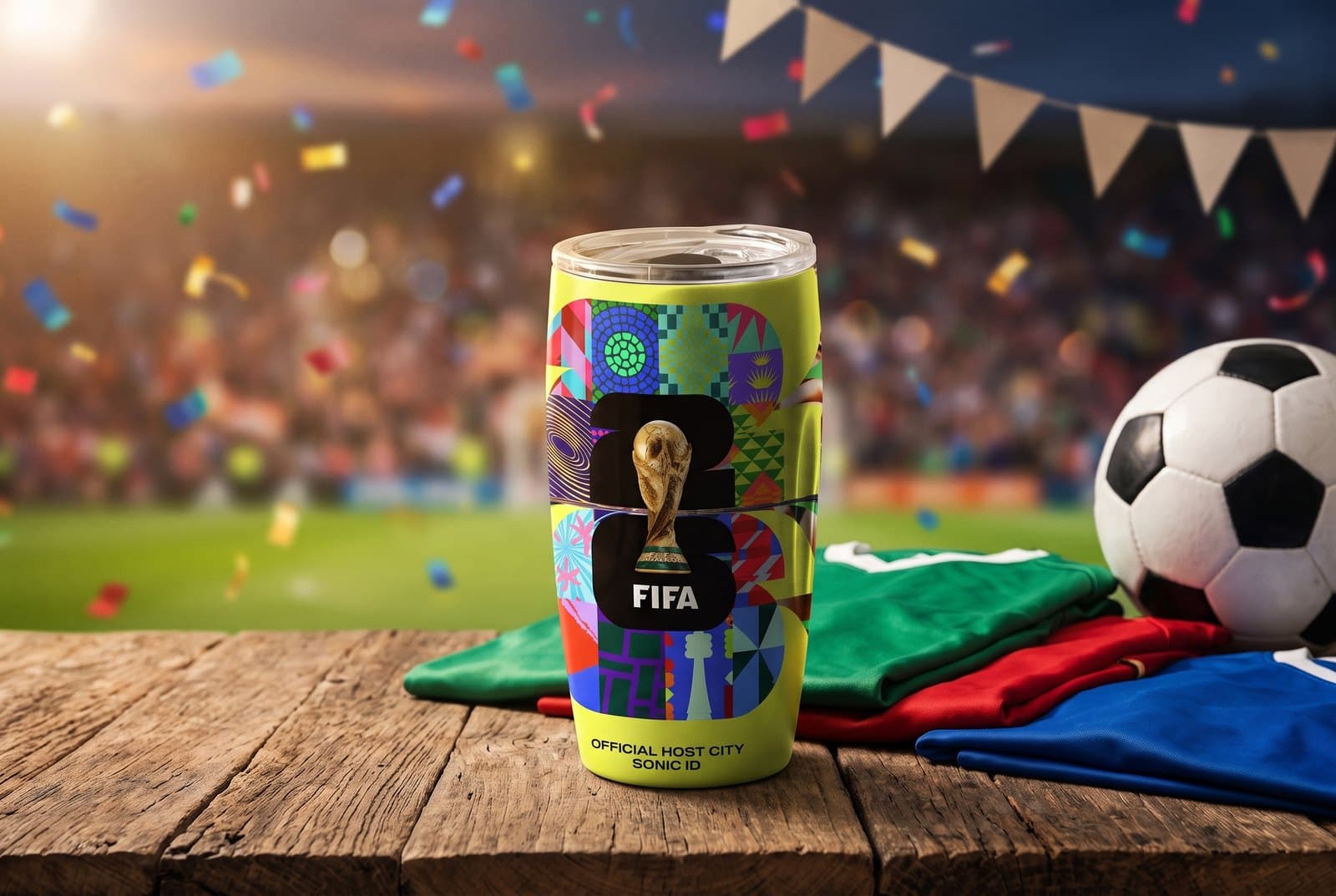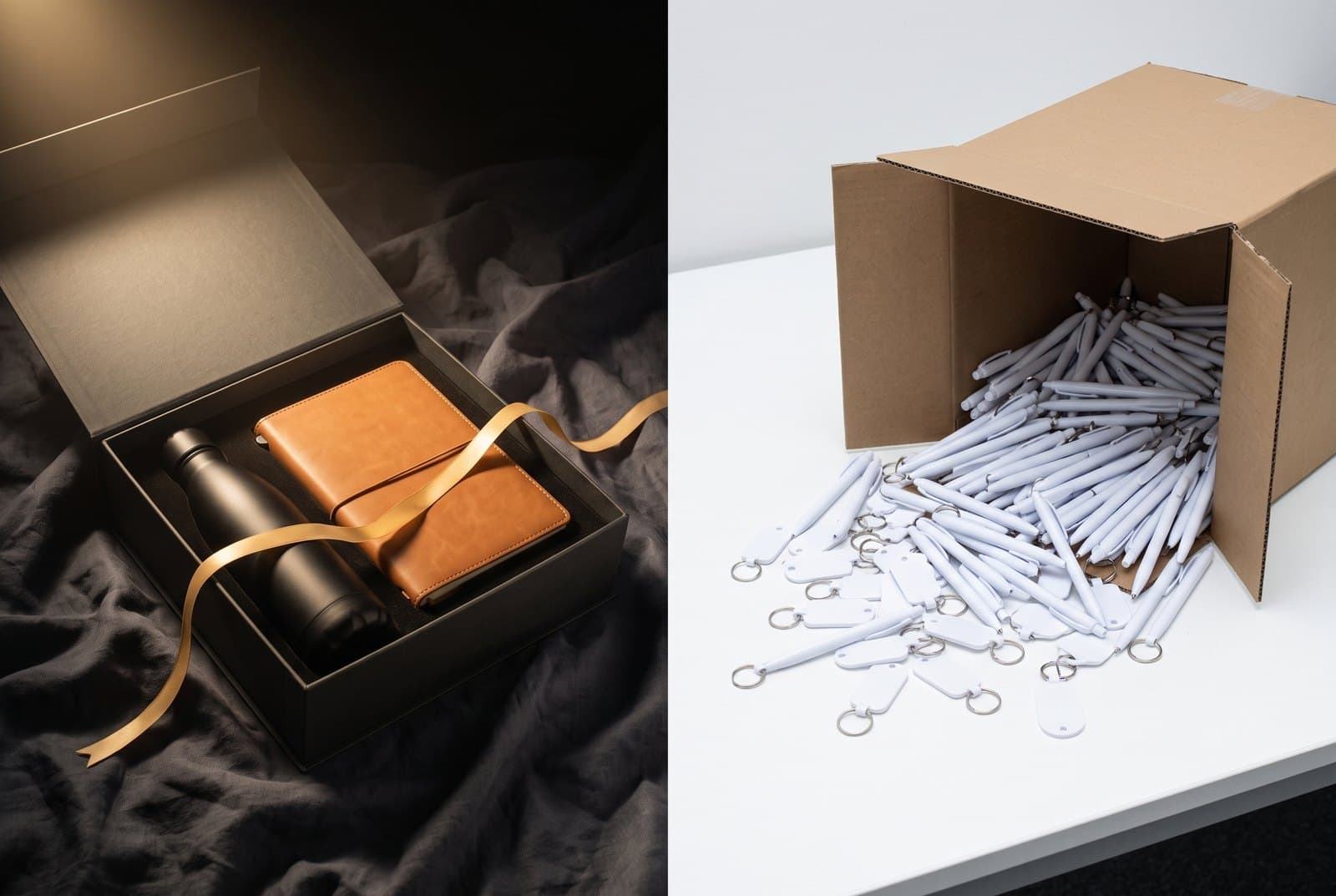
The word does more damage than the budget. 'Gift' turns up in nearly every merchandise brief written in this country, and it is asked to carry two products that have almost nothing in common: the thing a client keeps on their desk for three years, and the thing that is in a bin before the roadshow finishes packing down. Same word. Opposite engineering. Opposite economics. The brief rarely says which one it means, because the person writing it has not been made to choose.
You can settle it by walking through a client's office in, say, late September. Aidilfitri fell on 21 March this year. Six months on, the engraved flask is still there beside the monitor, catching the light. The pen from the same campaign is gone, and nobody could tell you when. That gap is not luck and it is not budget. It is a decision — premium corporate merchandise, built to be kept, or GWP, built to be handed out — and it gets made either at the briefing stage or by accident at the quotation stage. One of those is considerably cheaper.
The only score that counts is what is still there in September
Corporate merchandise sits at the premium, relationship end, and a single feature defines it: it is made to be kept. An engraved vacuum flask. A bonded-leather folio. A polo cut properly rather than cut to a price. Quantities run from tens to low thousands, unit cost is higher, and the material, finish and decoration are all chosen with a five-year desk in mind. The recipient is someone whose relationship you would be annoyed to lose — a key account, a JV partner, a senior hire, a colleague marking twenty years.
The retention test is the whole scorecard, and in Malaysia the climate quietly rewrites the shortlist before you get to it. A breathable, well-cut polo will be worn; a heavy zip-through fleece, bought because it photographed well in a catalogue shot taken somewhere with a winter, will sit in a cupboard in Shah Alam until somebody clears the store. Anything that assumes seasons we do not have is a gift the recipient has to find a use for. That is the wrong way round. The craft here is giving someone something they were going to want anyway, then putting your name on it.
GWP is not a cheaper gift. It is a different product.
Gift with purchase lives at the volume end, and every number inverts. Unit cost is low, quantities run into the thousands, and the working life is short deliberately. The tote pressed into your hands walking into a mall atrium activation, the sachet taped to a pack at a hypermarket, the pen in a conference delegate bag — none of it is trying to survive the decade, and holding it to that standard is a category error.
Its job is reach and conversion: nudging a shopper over the line, putting a new SKU into a lot of hands quickly, making one booth memorable in a hall of two hundred at KLCC or SPICE. Success is counted in volume, cost per piece and the lift it drives. A GWP has done its work the moment it changes hands. If it disappears the following week, it has already paid.
Which is why the most expensive mistake in promotional buying is not overpaying. It is misclassification — dressing a mass giveaway in finishes nobody will look at twice, or handing your most important client something that reads as a giveaway. The first wastes money quietly. The second costs you something you cannot re-quote.
Quality, MOQ, price: pick two
Three variables move against each other on every job — quality, minimum order quantity and unit price — and nobody wins all three. Corporate merchandise buys quality and pays for it with a high unit price at a low MOQ. GWP buys a low unit price at a high MOQ and accepts quality that only has to be adequate. Name the one you refuse to compromise on and the quotation stops being a guess.
MOQ is where most Malaysian briefs actually break, and it is arithmetic, not strategy. A stock item carries an MOQ of 500. Your headcount is 380. You now choose between paying for 120 pieces you will store, changing the item, or accepting a different decoration method that lowers the minimum — and that conversation is far easier in October than in the second week of February, when everyone else is having it too.
Two levers move the price most. Quantity is the first: setup and tooling spread across the run, so a 5,000-piece GWP is a different world per unit from a 200-piece executive gift. Decoration is the second, and it is the one buyers underrate. A one-colour silkscreen is cheap. Laser engraving, embroidery, debossing and full-colour UV printing cost more and, in the same motion, supply the perceived value that makes a premium gift read as premium. Goldvest brought that work in-house in 2019 — UV flatbed, laser, embroidery, silkscreen under one roof in Penang — and the reason it matters is unglamorous: the method is where a flat item becomes a considered one, or fails to, and that is not a decision you want made by whoever happened to be free.
Two more numbers belong in the same conversation and are usually left out of it. Most quotations are before SST, and sales tax on goods manufactured in or imported into Malaysia runs at 5% or 10% depending on the item — full enforcement of the expanded regime came in on 1 January 2026, so a supplier quoting you tax-inclusive and a supplier quoting you tax-exclusive are not offering the same price. And with the ringgit around RM4.09 to the US dollar after roughly a 10% appreciation through 2025, imported stock is cheaper in ringgit than it was two years ago. A dollar-denominated quote issued in January and honoured in August is a different number. Ask which it is.
The line that settles most briefs
Match the item to the objective, never the objective to whatever is in stock. If the aim is to deepen a relationship — onboarding a senior hire, thanking a key account, marking a company anniversary, leaving something behind after a boardroom pitch — corporate merchandise earns the higher unit cost, because being kept and noticed is the entire mechanism.
If the aim is scale — footfall to a stand, a reward for buying, a product sampled, a logo into ten thousand hands across a Deepavali retail push — GWP is the correct tool, and paying premium-gift money for it is a straightforward waste.
One question settles the rest: would you be pleased, or slightly embarrassed, to hand this to your most important client? Pleased, and you are in corporate territory and should stop optimising the unit price. Only makes sense by the thousand, and it is GWP, so stop specifying finishes for it.
Tier it, or the two jobs eat each other
Plenty of briefs need both, and the good campaigns say so out loud. A product launch pairs a premium gift for press and VIPs with a high-volume giveaway for the floor: one story, two budgets, two audiences, one purchase order. A conference runs a keepsake for speakers and sponsors alongside something cheap for everyone who walks through the door. Nobody is fooled, and nobody is meant to be.
The failure mode is the untiered brief — one item, one spec, stretched to cover a CEO and a walk-in. It always lands wrong at one end. Decide who each tier is for first, then let quality, MOQ and price settle around that, and plan it against the calendar rather than against the panic. Chinese New Year falls on 6 February 2027 and Aidilfitri on 10 March 2027 — thirty-two days apart, with the Chinese factory shutdown for the new year sitting squarely between them. Briefs written in December for both will get one of them right.
Bring us your brief.
Not sure which end of the scale your brief sits on? Tell us the audience, the quantity, the date it has to land and what you want people to do with the thing — and we will come back with options, real samples, and an honest view of where the budget is doing the most work.
Start a brief